RGreview-game-corethe engine behind concept-first review games

Shared TypeScript package for review-game apps

Build review games without rewriting routing, retries, and spaced review.

`review-game-core` is the decision layer behind the course apps in this workspace. It chooses the next concept, tracks quiz turn state, decides when to open support or recovery, schedules spaced return after independent work, and evaluates which study track a learner should do next.

What one learner turn includes

A learner turn moves through six named states: route, question, staged answer, support, recovery, complete.

Consumer apps own the UI, content, and data. The core owns the workflow logic so the product does not drift into ad hoc quiz behavior.

One real API surface

import { evaluateGoalPlan } from '@brandon-gottshall/review-game-core'

const evaluation = evaluateGoalPlan(plan, snapshots, {
  localDate: '2026-04-16',
})

const nextTrack = evaluation.trackPriority[0]
// Use this to decide which launcher card or study track
// the learner should see first today.

Module split

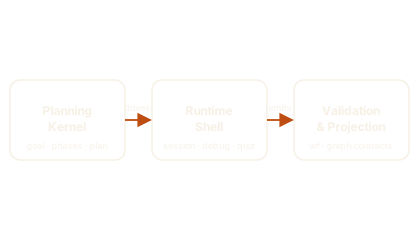
The turn engine handles route, question, staged answer, support, recovery, and complete; the concept scheduler chooses when a concept returns; the goal evaluator tells the launcher which track to surface next.

Turn engine

State machine for a learner turn. It keeps routing, question state, staged answers, support, recovery, persistence, and debug hooks in one place — plus a content-identity seam so a restored turn can be compared against current authored content before it is resumed.

workflow/quiz-engineworkflow/sessionworkflow/debug

Concept scheduler and repetition ladder

Concept mastery and spaced-return logic with the guided rep ladder — light, hard, and recovery-light phases — and named selection reasons the launcher can surface without inventing its own vocabulary.

schedulerconceptmasteryguided-repetition

Goal evaluator and projection

Launcher and study-plan logic. It reads dated phase snapshots and returns a next-track recommendation such as primary, catch-up, queued, or complete.

goalgraph/projectorgraph/contracts

Readiness and phase state

A coarse 0–100 readiness signal plus a six-value phase vocabulary that rolls up honestly. Good for routing and launcher copy, intentionally not an assessment instrument.

readinessscheduler/phase-state

Experiment gating and WF harness

Deterministic cohort resolution, exposure records, and served-question metadata let experimental or LLM-variant questions ride the same turn engine — with the WF harness gating them before learner exposure.

workflow/interventionswf-harness

stats-exam-prep-game

Exam-track goal coach in stats

The stats launcher turns concept progress into a clear next-track recommendation without embedding learner planning into the core itself.

goalschedulerworkflow

math-1111-review-game

Section-native study brief in Math 1111

Math1111 converts section completion and deadline windows into a unit recommendation while keeping course policy, sources, and learner identity out of the core.

goalworkflowgraph contracts

core

WF contract validation in the core

The shared WF harness keeps type coverage, payload shape, concept consistency, and scheduler expectations testable before browser-level regression or low-context WF passes.

wf-harnessschedulerquestiongenerator

state-machine

Planning / goal abstraction

Ordered phases, local-date deadlines, and recommendation roles let consumer apps turn progress counts into a clear next track.

goal

state-machine

Scheduler

Concept-level mastery math, spacing, and next-concept selection stay policy-driven so each game can own its own UI and gating rules.

schedulerconcept

state-machine

Guided repetition ladder

Concept-first rep phases — light, hard, and recovery-light — with explicit attempt budgets and selection reasons so apps can teach first, then fade to independent proof.

schedulerconcept

code-snippet

Readiness scoring and phase state

A coarse 0–100 readiness signal and a six-value phase vocabulary (not_started, learning, practicing, mastered, shaky, tracked_in_quiz) that products can roll up without overclaiming.

readinessscheduler/phase-state

consumer-flow

Workflow quiz engine / session / debug

The quiz engine runs a turn through six phases; session and debug helpers let consumer shells persist and force routes deterministically.

workflow/quiz-engineworkflow/sessionworkflow/debug

code-snippet

Content-identity restore seam

Session snapshots carry an optional content identity (questionId, contentId, contentVersion) so a restored turn can be compared honestly against current authored content before it is resumed.

workflow/sessionworkflow/persistence

code-snippet

Per-question experiment gating

Deterministic cohort resolution, exposure records, and served-question metadata for experimental or LLM-variant questions — so gated content stays visible, auditable, and WF-testable before it reaches learners.

workflow/interventions

code-snippet

WF harness

The harness validates static well-formedness across question coverage, payload shape, concept wiring, generator determinism, and scheduler scenarios.

wf-harnessschedulergenerator

code-snippet

Graph contracts / query / projector

The graph layer projects authored learning structure into Neo4j as a rebuildable read model instead of turning the graph into an operational source of truth.

graph/contractsgraph/querygraph/projector

code-snippet

Concept tree + question / generator primitives

Questions, concepts, and seeded generators stay minimal so consumer repos can shape content and rendering without fighting a heavyweight framework — with room for a concept-first rubric (disclosure, scaffold-then-fade) above the core types.

questionconceptgenerator
Getting Started

Quick Start

Minimal imports for questions, concepts, generators, scheduling, and workflow contracts.

Open page

Graph

Graph Subsystem

Projection-first graph contracts, query helpers, and Neo4j read-model boundaries.

Open page

Overview

Introduction

Start here for the package framing, site structure, and the three public surfaces of the docs site.

Open page

Overview

Installation and Package Structure

Install the package, understand the source-first layout, and see how the site fits into the repo.

Open page